

Europe did something hard and did it well. In 2017, the European standards body published one semantic model of an invoice, EN 16931: the elements an invoice must carry, what each means, and the rules that hold between them. Two syntaxes are bound to it, one of them the OASIS Universal Business Language, so the same invoice can be written as UBL or as the UN/CEFACT cross-industry format and mean the same thing. Since 18 April 2019 every central public body in the Union has had to accept invoices in it. From 1 July 2030, under the directive adopted on 11 March 2025, invoices for supplies between member states must be electronic and comply with that standard.
So a company that sells in five European countries has one invoice standard to meet. Here is what it actually has to meet.
Six calendars
Italy went first and went its own way. Since 1 January 2019 every invoice between parties resident in Italy has had to be electronic, sent through the tax authority’s exchange system in the authority’s own XML format, which predates the European norm and is not a profile of it. A 2022 decree removed the last exemption: from 1 July 2022 for businesses with more than 25,000 euros of revenue, and from 1 January 2024 for everyone else.
Poland switched on its national e-invoice system this year: from 1 February 2026 for businesses whose 2024 sales exceeded 200 million zloty, from 1 April 2026 for everyone else, with a transition to the end of the year for the smallest monthly volumes. The invoice is a structured document in the ministry’s schema, submitted to the ministry’s system.
Belgium made structured electronic invoices mandatory for all VAT-registered Belgian businesses from 1 January 2026, and its federal guidance is built around the Peppol network the country already used for invoices to government.
France keeps its legal calendar: from 1 September 2026 every company in scope must be able to receive electronic invoices, large and mid-size companies must issue them from the same date, and small and micro companies from 1 September 2027, all through an accredited platform, because the tax code now says issuing, transmitting and receiving run through one.
Germany wrote its transition into the VAT Act itself. An electronic invoice is the rule for transactions from 1 January 2025; paper or other formats remain acceptable until 31 December 2026, and until 31 December 2027 for businesses with turnover under 800,000 euro.
The Union fixes the horizon: 1 July 2030 for cross-border supplies, in the European standard. And in the same article it says that member states “may allow the use of other standards for electronic invoices relating to supplies of goods and services within their territory.” Which is to say: the country’s version stays legal at home, by design.
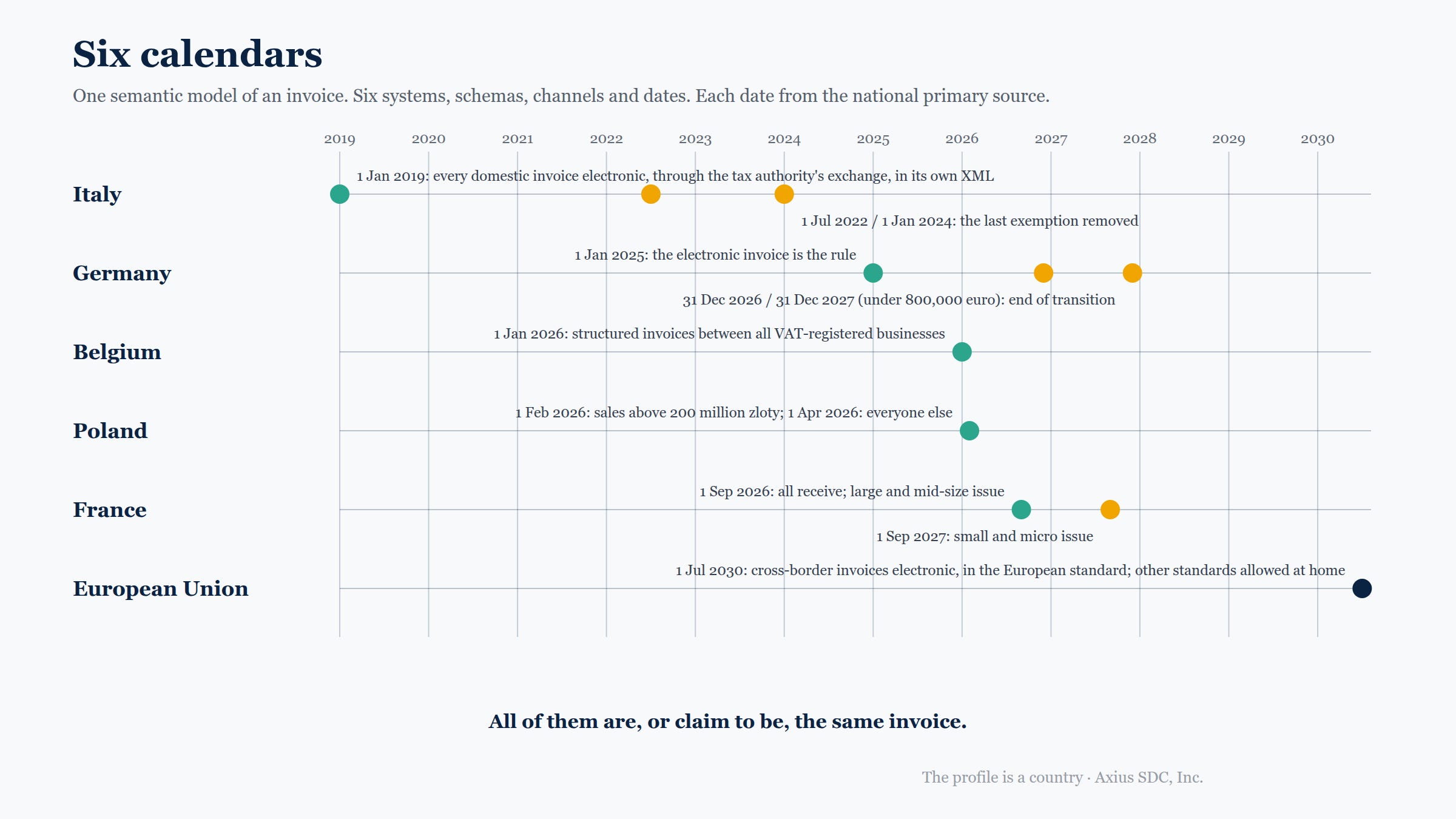
Five national mandates and one European one, each with its own system, schema or profile, transmission channel, and dates. All of them are, or claim to be, the same invoice.
How one standard becomes a country
The mechanism is in the standard’s own vocabulary. The semantic model is deliberately wide. A country, a sector, or a network narrows it with a usage specification: a published list of which optional elements become mandatory, which codes are allowed, and which rules apply. The European norm has a name for this narrowing: a core invoice usage specification, and a rule for it: a usage specification “may only restrict the data model”; an extension “extends or changes” it. Peppol’s billing specification, the one most of these countries route through, says of itself that it “is a Core Invoice Usage Specification (CIUS) of EN 16931,” and it carries an appendix of national rules, one prefix per country.
Where do those rules live? Not in the schema. The schema is the wide one; it validates the Belgian invoice, the French one, and the Norwegian one alike. The narrowing is a second file, in a rule language that runs alongside the schema, published by the country or the network, versioned on its own calendar, and optional for any validator that wasn't told to run it. The invoice carries two identifiers, a customization and a profile, that say which narrowing the sender had in mind. They are strings. Nothing in the document enforces them.
That is the whole structure, and it is the same structure I described in July for clinical data and for government data: a maximal base everyone agrees on, and a soft layer beside it where the meaning for one exchange actually lives, written per country, per network, per partner, by whoever needs the exchange to work. The base is free. The soft layer is the bill.
What the bill is
Two costs, and they are not the same cost.
The first is the project. A company invoicing in five countries conforms to five narrowings of one model, and in Italy to a format older than the model. Each has a document to read, a mapping to write, a validator to configure, a platform or network to connect to, and a date. The dates in this piece are the first cost’s calendar, and finance teams across Europe are living inside it right now. It is a real number, and it is usually budgeted honestly.
The second is the one that does not get a line. The narrowings change. A national rule set gets a new version, a code list gains a value, a platform’s technical rules move, a threshold shifts a company from one calendar to another. Each change lands in the soft layer, beside the schema, and each one has to be found, read, understood, and applied by the company’s own people, per country, forever. Nobody invoices that. It shows up as headcount in a team whose job title doesn't mention it, and as the eleven days I wrote about on Monday, when two companies had followed the rules they held and couldn't show each other which rule applied on which date.
I will concede the design-time half: a model whose constraints live inside its components costs more to build the first time than a wide schema with a rule file beside it. That is the one place the second approach is dearer, and it is paid once.
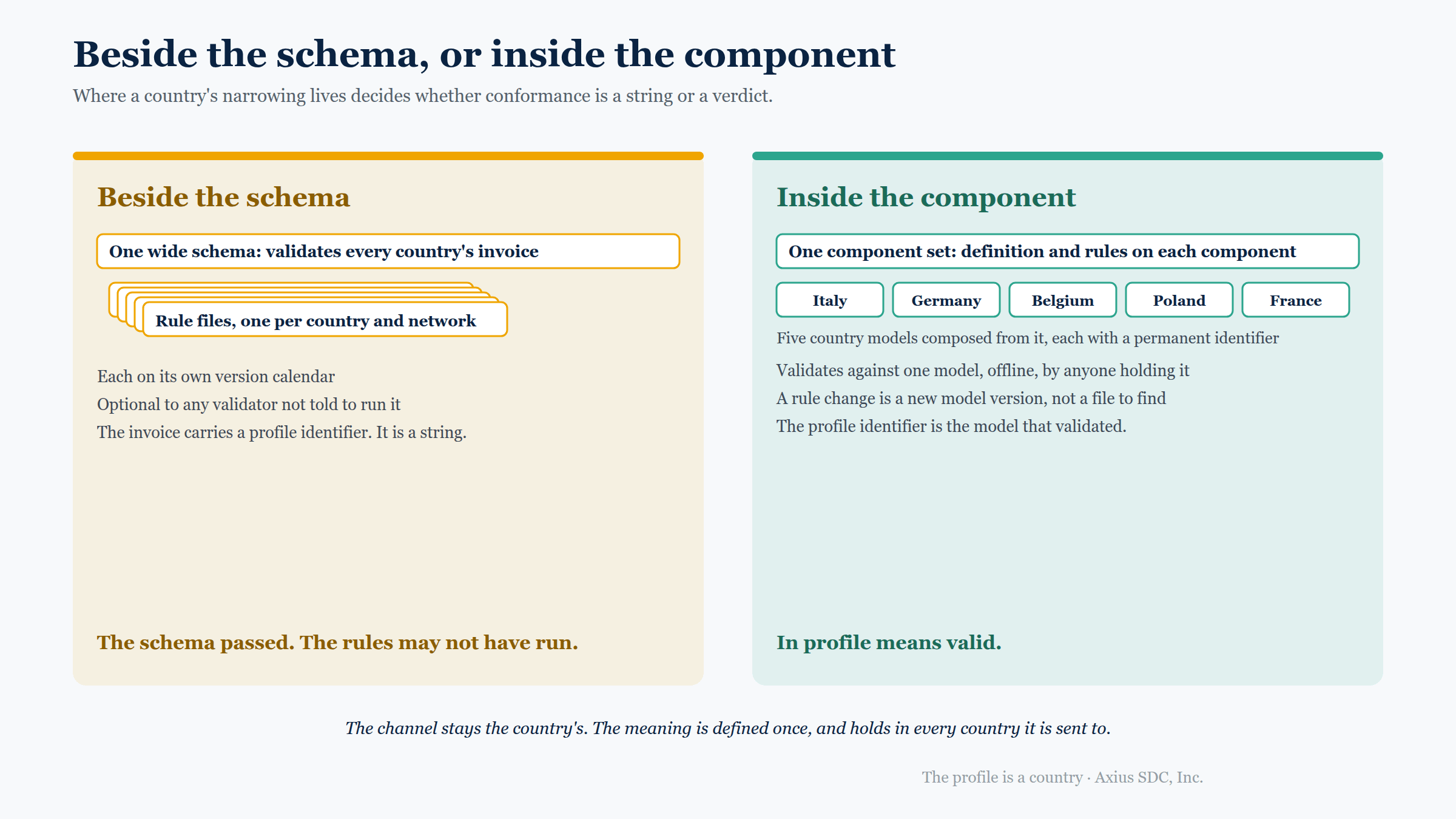
The profile as a model
Here is the alternative, and it is not a new standard. It is a different place to put the narrowing.
Build the invoice from components that each carry their own definition, their permitted values, and the rules that apply to them, published with permanent identifiers. Then a country’s profile is not a rule file beside the schema. It is a model: the same components, composed for that country, with that country’s constraints inside the components it adds or restricts. Conformance to the country is validity against the model. A document that validates is in profile; one that does is not; there is no third state where the schema passed, and the rule file was not run.
I have been building this autumn for the supply chain with a fictitious food manufacturer, Halvorsen Foods, and two fictitious retailers. The second retailer orders under its own profile: a delivery window no longer than ten days, a set of required references, its own terms. That profile is a published model on the same component set as the first retailer’s, and the supplier reads both into the same record shape. The window rule is not a note in an implementation guide; it is an assertion in the schema, and an order that breaks it does not validate. Two profiles, two models, one component set, and the same component means the same thing in both.
We have done it for the network most of these countries route through. Peppol’s billing profile is published the same way, on the same components: its mandatory elements are rules in the schema, and an invoice that breaks one does not validate. Do that for each country; each country is a model. Five countries are five models on one component set, each one checkable offline by anyone who holds the document, and a change to a national rule is a new version of a model with a permanent identifier, not a new file to go and find. The customization identifier stops being a string the reader has to trust and becomes the identifier of the thing that validated.
None of this changes who sends what to whom. The invoice still goes through the national system or the accredited platform or the Peppol access point, in the format the country mandates, written by the company’s own translator from the Governed Data Record. The channel is the country’s. The meaning is the company’s, defined once, and it holds in every country it is sent to.
The business documents page has the component library and the schedule. The thirty-day audit runs on your own invoices, against the profiles you already conform to, before anyone signs anything.
Sources
Council Directive (EU) 2025/516 of 11 March 2025 amending Directive 2006/112/EC as regards VAT rules for the digital age, OJ L, 25 March 2025: the amendments “with effect from 1 July 2030,” Article 218 as amended (”invoices shall be issued as electronic invoices”; “Electronic invoices shall comply with the European standard on electronic invoicing and the list of its syntaxes pursuant to Directive 2014/55/EU”; “Member States may allow the use of other standards for electronic invoices relating to supplies of goods and services within their territory”). http://data.europa.eu/eli/dir/2025/516/oj
Agenzia delle Entrate, La fattura elettronica e i servizi gratuiti dell’Agenzia delle Entrate: “Dal 1° gennaio 2019 tutte le fatture emesse ... tra soggetti residenti o stabiliti in Italia, potranno essere solo fatture elettroniche”; “introdotto dalla Legge di Bilancio 2018”; the Sistema di Interscambio. https://www.agenziaentrate.gov.it/portale/documents/d/guest/la_fattura_elettronica
Ministerstwo Finansów, KSeF: “od 1 lutego 2026 r. dla firm, które w 2024 r. miały sprzedaż powyżej 200 mln zł”; “od 1 kwietnia 2026 r. dla pozostałych”; the 10,000 zloty monthly transition to 31 December 2026. https://ksef.podatki.gov.pl/od-kiedy-trzeba-wystawiac-faktury-w-ksef/
FPS Finance (Belgium), einvoice.belgium.be: “Since 1 January 2026, all Belgian enterprises liable to VAT will have to use structured electronic invoices in their transactions with each other.” Legal references on the same site: the law of 6 February 2024 and the 2025 royal decrees. https://einvoice.belgium.be/en
DGFiP, Facturation électronique : guide pratique de démarrage au 1er septembre 2026: “À compter du 1er septembre 2026, les entreprises concernées par la réforme doivent avoir la capacité de recevoir des factures électroniques”; “À compter du 1er septembre 2026, les grandes entreprises et les entreprises de taille intermédiaire ...”; “Pour les PME, TPE et micro-entreprises, cette obligation d’émission s’applique à compter du 1er septembre 2027”; article 289 bis CGI on the plateforme agréée. https://www.impots.gouv.fr/sites/default/files/media/1_metier/2_professionnel/EV/2_gestion/290_facturation_electronique/guide_pratique_facturation_electronique.pdf
Umsatzsteuergesetz § 27 Absatz 38 (transitional provisions for the electronic invoice under § 14 Absatz 1 Satz 6): “bis zum 31. Dezember 2026 für einen nach dem 31. Dezember 2024 und vor dem 1. Januar 2027 ausgeführten Umsatz auf Papier oder ... in einem elektronischen Format, das nicht § 14 Absatz 1 Satz 6 entspricht”; the 800,000 euro threshold to 31 December 2027. https://www.gesetze-im-internet.de/ustg_1980/__27.html
Decreto-legge 30 aprile 2022, n. 36, articolo 18, commi 2 e 3: the exemption in article 1, comma 3, of Decreto legislativo 5 agosto 2015, n. 127 removed, applying “a partire dal 1° luglio 2022 per i soggetti che nell’anno precedente abbiano conseguito ricavi ovvero percepito compensi, ragguagliati ad anno, superiori a euro 25.000, e a partire dal 1° gennaio 2024 per i restanti soggetti.” https://www.normattiva.it/uri-res/N2Ls?urn:nir:stato:decreto.legge:2022-04-30;36~art18
CEN, EN 16931-1:2017, Electronic invoicing, Part 1: Semantic data model of the core elements of an electronic invoice, published 28 June 2017, with CEN/TS 16931-2:2017, the list of syntaxes. The Austrian federal e-invoicing service on the standard: “This data model was specified for the syntaxes UBL 2.1 (Universal Business Language) and CII D16B (Cross Industry Invoice)”; “Directive 2014/55/EU requires all primary public administration bodies in all member states to accept e-invoices in these formats since April, 18th 2019”; “A CIUS may only restrict the data model, while an Extension extends or changes the data model.” https://www.erechnung.gv.at/erb/en_GB/info_en16931
OpenPeppol, Peppol BIS Billing 3.0: “This specification, is a Core Invoice Usage Specification (CIUS) of EN 16931, following the guidance given in chapter 7 of the EN 16931”; Appendix C, national rules. https://docs.peppol.eu/poacc/billing/3.0/bis/
OASIS, Universal Business Language Version 2.3, OASIS Standard, 15 June 2021. https://docs.oasis-open.org/ubl/os-UBL-2.3/UBL-2.3.html
Go deeper: Business documents on the Semantic Data Charter.
Tim Cook is CEO of Axius SDC, Inc. The Semantic Data Charter is an open-source specification (Apache 2.0) for self-describing, structurally governed data models. semanticdatacharter.com | Practitioner Program